Receiving an administrative complaint from the Florida Department of Agriculture and Consumer Services (FDACS) can feel like a heavy weight on your shoulders. You have worked hard to build a career in the private investigative or security industry, and suddenly, a legal notice threatens your ability to earn a living. It is normal to feel overwhelmed, frustrated, or even blindsided by the technical details of Florida’s regulatory statutes. In these moments, defending your Florida private investigative license becomes critical to protecting your reputation and professional future.
Elevate Legal Services, PLLC, wants you to understand that a complaint does not equal a final judgment. The law provides several options to challenge allegations, protect your professional reputation, and maintain your license. This guide explains the legal issues involved, outlines the accusations from the Florida Department of Agriculture and Consumer Services, and presents a clear strategy for defending your Florida private investigative license.
Call Elevate Legal Services, PLLC today on 561-770-3335 for a confidential consultation, or contact usto speak with an attorney about your matter.
By the time you finish reading, you will understand the definitions of F.S. 493.6118(1)(t)and 493.6303(4)(a), the critical deadlines you cannot afford to miss, and how professional representation can mitigate or eliminate the penalties against you.
Professional Guidance from Elevate Legal Services, PLLC
 Elevate Legal Services, PLLCis a dedicated Boca Raton law firm with a deep focus on administrative law and professional license defense. We understand that behind every case file is a professional who simply wants to do their job and provide for their family. Our team of experienced attorneys is authoritative yet empathetic, ensuring you feel supported throughout the entire legal process.
If you are currently holding a complaint and aren’t sure what to do next, we are here to help. You can reach our office at 561-770-3335 or email us directly at [email protected] to schedule a consultation regarding your FDACS matter.
Decoding the Charges: F.S. 493.6118(1)(t) and 493.6303(4)(a)
When you look at your administrative complaint, the numbers can look like a foreign language.
Here’s what that means legally.
These specific citations tell the story of what the state believes went wrong. They are not merely suggestions; they are the legal pillars upon which the state builds its case to revoke or suspend your license.
What is F.S. 493.6118(1)(t)?
This is often referred to as the “compliance” statute. Florida Statute 493.6118(1)lists various grounds for which disciplinary action may be taken against a licensee.
Subsection (t)specifically targets the “failure to comply with any provision of this chapter.” Because Chapter 493 is the massive body of law governing private investigators, security guards, and recovery agents, this is a broad charge.
It essentially means the FDACS believes you violated a specific rule or regulation found anywhere within the hundreds of pages of Chapter 493. It is often used as a “catch-all” to ensure the state has the authority to penalize any deviation from the law.
Understanding F.S. 493.6303(4)(a)
This statute is more specific and typically applies to Class “D” Security Officers. This section governs the application process and the mandatory training requirements.
Under 493.6303(4)(a), the FDACS examines whether the applicant or licensee has met the stringent 40-hour training requirements or if there was an issue with the initial application documentation.
If you are being cited under this section, the state may be alleging that:
- Your training certificates were invalid or incomplete.
- There was a material misrepresentation on your application.
- The school where you received training did not meet state standards.
The Clock is Ticking: The Election of Rights
The most important thing to understand right now is this: You only have 21 days.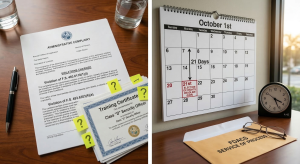
From the moment you are served with the administrative complaint, the “clock” begins. You must file an Election of Rights (EOR)with the FDACS within 21 days.
If you miss this deadline, you waive your right to a hearing. The FDACS can then move straight to a “Final Order,” which usually results in the maximum penalty, including the revocation of your license.
Your Three Choices on the EOR
When you fill out the Election of Rights, you generally have three paths:
- Formal Hearing:Use this if you dispute the facts the FDACS has presented. Your case will be heard by an Administrative Law Judge (ALJ)at the Division of Administrative Hearings (DOAH).
- Informal Hearing:Use this if you admit the facts are true but want to argue for a lower penalty (mitigation).
- Settlement Agreement:You and your attorney negotiate a “Stipulation” with the FDACS to settle the matter without a hearing.
The Legal Process: Step-by-Step
Navigating an administrative complaint requires following a very specific sequence of events.
- Receipt of Complaint:You are formally served with the Administrative Complaint and the Election of Rights.
- Consultation & Review:You meet with Elevate Legal Services, PLLC,to review the allegations and the investigative file.
- Filing the EOR:We file your Election of Rights within the 21-day window to preserve your career.
- Discovery Phase:We request all evidence, witness lists, and notes from the FDACS investigators.
- Negotiation or Hearing:We either negotiate a settlement (Stipulation) or represent you at a Formal/Informal hearing.
- Final Order:The Department head or the Board issues a final decision based on the hearing or agreement.
Why You Shouldn’t Go It Alone
It is tempting to try to call the FDACS investigator yourself to “clear things up.”
Do not take this risk.
Anything you say to an investigator can and will be used against you in a formal proceeding. Administrative law is a specialized field that operates differently from criminal or civil courts. At Elevate Legal Services, PLLC, we step in as your shield.
How Professional Representation Protects You:
- Evidence Review:We demand the state’s investigative file to see exactly what evidence they have against you.
- Procedural Accuracy:We ensure every motion and response is filed correctly and on time.
- Negotiation Power:We speak the FDACS attorneys’ language and know what types of settlements are standard.
- Expert Witnesses:If your case involves training disputes, we can bring in experts to verify your compliance.
The Potential Penalties
The FDACS takes violations of Chapter 493 very seriously. The goal of the Department is to ensure that only qualified, ethical individuals are working in the security and investigative sectors.
The stakes are high.
If you do not mount a proper defense, you could face:
- Administrative Fines:Often reaching thousands of dollars per violation.
- Probation:Staying on your record for years and affecting your insurance rates.
- License Suspension:Forcing you out of work for a set period.
- Permanent Revocation:Ending your career in this industry in the State of Florida.
The Path Forward with Elevate Legal Services, PLLC
Facing the Florida Department of Agriculture and Consumer Services can feel like a David-versus-Goliath battle. However, the law still protects your rights throughout the process. You have the right to due process, to review the evidence presented against you, and to work with legal counsel when defending your Florida private investigative license.
At Elevate Legal Services, PLLC, we focus on practical, solution-oriented defense. We don’t just look at the law; we look at your life and your goals. Whether it’s negotiating a reduced fine or fighting a factually incorrect complaint at a formal hearing, we are committed to your success.
Our firm handles a wide range of regulatory and compliance matters, ensuring that professionals across South Florida can continue to operate without the fear of bureaucratic overreach.
Take the First Step Today
Don’t let a 21-day deadline decide the fate of your career. Reach out to a firm that understands the intricacies of F.S. 493.6118(1)(t)and 493.6303(4)(a).
Contact Elevate Legal Services, PLLC today at 561-770-3335 or fill out our contact formfor a professional consultation. We are ready to defend your license and your future.
We are ready to listen to your story and help you find the best path forward.
Frequently Asked Questions (FAQ)
1. Can I still work while the administrative complaint is pending?
In most cases, yes. Unless the FDACS has issued an “Emergency Suspension Order” (which is rare and reserved for immediate threats to public safety), your license remains active until a Final Order is signed.
2. What is the difference between a Formal and an informal hearing?
A Formal Hearing is like a trial where you challenge the facts before an Administrative Law Judge. An Informal Hearing is for when you agree the violation happened but believe the penalty should be lighter due to “mitigating circumstances.”
3. Does a violation of my Florida license affect my licenses in other states?
It can. Many states have reciprocity or disclosure requirements. If you are disciplined in Florida, you may be required to report that discipline to other state licensing boards, which could trigger secondary investigations in those jurisdictions.
4. What are “mitigating circumstances” in an FDACS case?
These are facts that don’t excuse the violation but make it less severe in the eyes of the law. Examples include a long history of no prior violations, cooperation with the department, or taking immediate steps to fix a clerical or record-keeping error once discovered.
5. Is it expensive to hire a lawyer for an FDACS complaint?
The cost of hiring an attorney often remains far lower than the long-term consequences of losing your career, paying maximum fines, and carrying a “revocation” on your permanent public record. When defending your Florida private investigative license, strong legal guidance can make a critical difference in protecting your livelihood.
Would you like me to review the specific allegations in your complaint to determine if you should elect a Formal or Informal hearing?